.png)
.png)
As a fashion digital marketing agency, we speak to dozens of fashion brands about growth every month, and we hear the exact same story.
Ad spend is increasing year over year, and the ROAS in Meta and Google looks fantastic but behind the scenes actual ecommerce revenue is flat or declining.
Their agency are telling them to scale into the ROAS, yet finance is questioning what they’re actually getting for their paid media investment.
We call this ‘Platform Reality’ - and it’s a dangerous place for a fashion brand to be.
Brands get so caught up in platform-reported metrics that they blindly lean in, assuming that if they spend more, revenue will follow. In recent years, brands might’ve been able to get away with living in the world of inflated ROAS and vanity metrics, but in 2026 that is going to cost brands their profit margin and steal them of their growth.
Here's how to escape platform reality and get back to actual growth.
Stop paying for customers you already own
A good step towards escaping the Platform Reality trap is to look at how many of your existing customer sales your campaigns are taking credit for.
It’s pretty eye-opening when you realise that the amazing ROAS Google or Meta has been showing you is mostly generated by hoovering up cheap sales from your existing customers - sales you likely would’ve gotten anyway.
The goal of any paid advertising spent on existing customers is to drive as much incremental revenue as possible, and you do this by segmenting your customer base and targeting specific cohorts.
If you have a CRM system like Klaviyo or Ometria, you will be able to segment your customer base into smaller buckets, such as active customers, first-order-only customers, and lapsed customers.
Once you have the right segmentation in place, you can start to target the customers who are actually going to drive incremental revenue. You don’t want to go after the customers who are coming back time after time; leave that to email.
Lapsed or lost segments are a great place to start. Usually, these are people who have not bought in the last X days/months/years. It’s unlikely they are going to come back without you actively re-engaging them with the brand.
Converting one of these customers can be almost as good as winning a new customer, and it’s normally cheaper because they’re already aware of your brand.
Start tracking in-business metrics
The first step to truly breaking out of Platform Reality is to look beyond the inflated platform metrics (ROAS, cost per sale, etc.) and start reconciling your ad spend against your actual e-commerce revenue.
In-business or blended metrics are where you take all your digital marketing spend and compare it against your backend e-commerce revenue.
The benefit of this is that it allows you to look at your performance marketing holistically. Is it actually increasing revenue? Are you seeing new customers increase? Is your Cost Per Order (CPO) increasing or decreasing?
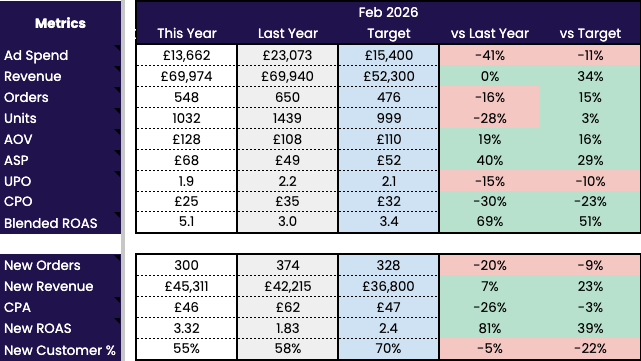
If you’re a brand selling across multiple regions, we highly recommend splitting this out geographically, as performance can look very different from region to region.
Including new customers is also critical. The ad platforms' view on new vs. existing customers is notoriously flawed, relying on customer lists and email match-up rates to identify who’s an existing customer and who isn’t. Having a single source of truth (your e-commerce platform) is essential.
Testing for incrementality
Many fashion brands might have a goal (e.g., grow new customers by 15% YoY), yet they don’t know where they need to deploy their budget in order to hit that target.
Do they need to expand into new territories? Spend more on PMax? Run more top-of-funnel activity?
This is where testing comes in, and a good place to start is a holdout test.
Holdout testing is where you stop advertising to a select audience to see what impact not seeing ads has on their shopping behaviours.
Due to the difficulty of excluding an exact audience inside the ad platforms, we usually suggest doing this geographically by excluding a specific city, state, or country that you want to test.
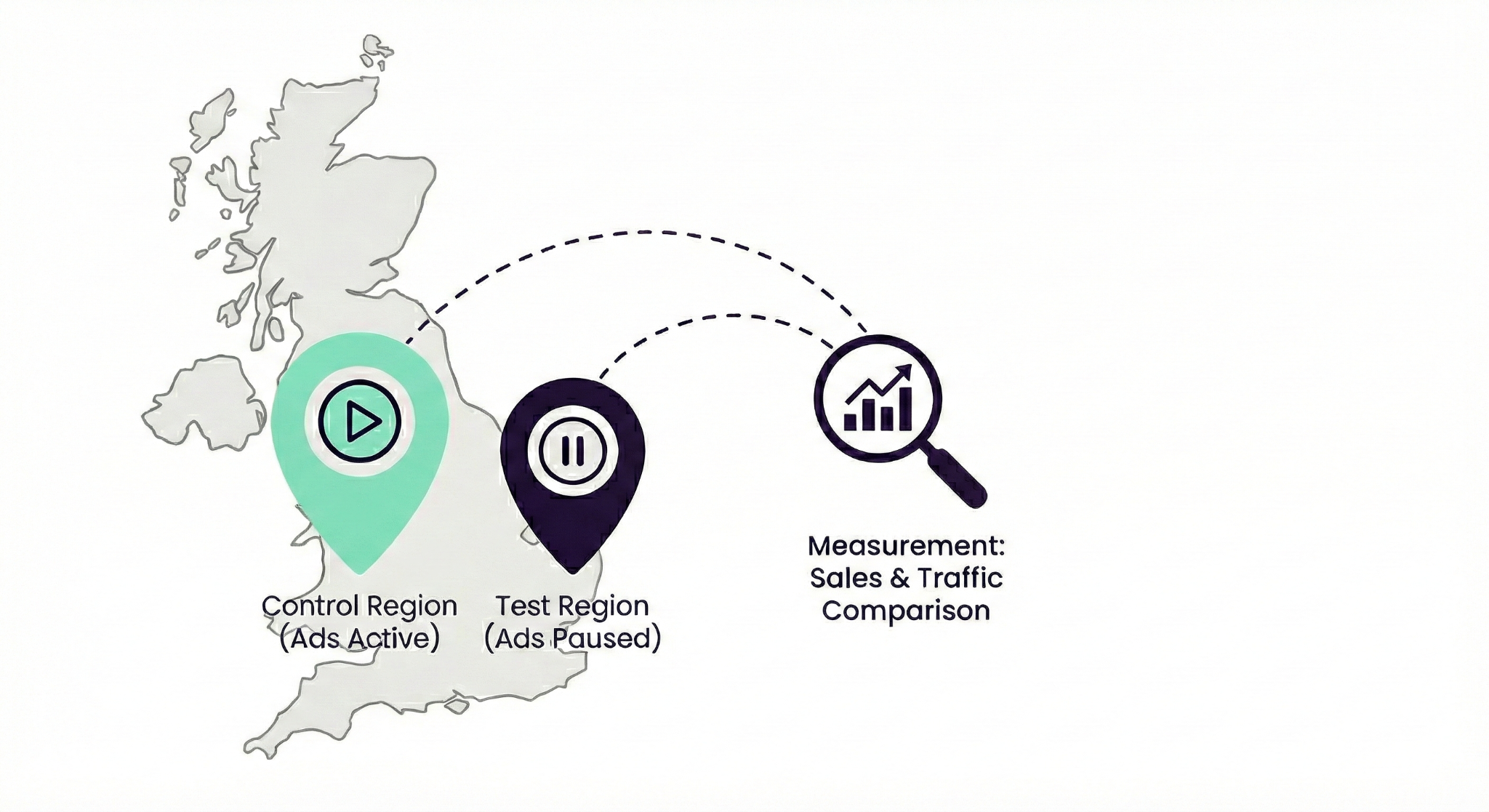
In an ideal world, you would see purchases from that audience drop, proving that your ads were the driving force behind their purchases.
Initially, you might want to test this across all your ad platforms to see the incremental impact of your overall ad spend. In time, you will want to narrow this down to see how purchase behaviour changes when you just exclude Meta, or just exclude PMax, etc.
Top Tip: Find another region that shows very similar purchase behaviour to your test region. This acts as a control group, allowing you to monitor the natural seasonal fluctuations you might see during your test.
Armed with this data, you will soon understand what platforms, regions, and campaigns you can invest in to actually move the needle - and which parts of your advertising are just hoovering up sales you would’ve gotten anyway.
Set targets to guide scaling
Once you know which campaigns are driving true incremental growth, the next step is ensuring that growth is actually profitable.
Google and Meta don't know your profit margins. They don't know your COGS, your fulfillment costs, and they certainly don't account for the high return rates seen in the fashion industry.
In Platform Reality, a campaign showing a 6.0 ROAS or a £40 CPA looks like a massive win, prompting the platforms to suggest you scale spend.
But in reality, once a 25-30% return rate and shipping costs are factored in, that exact same campaign might be actively losing the business money.
This is where having targets built around in-business metrics is crucial.
If you know that you can’t profitably go above a £25 cost per order, then you already know whether you should be scaling or not. By all means, use in-platform data as a directional guide for where you should be investing your budget (subject to your incrementality testing). But with these financial targets in place, you won’t be tempted to scale spend just because Google is telling you the ROAS is strong and you’re "limited by budget"!
Conclusion: Making the Shift to Revenue Reality
In 2026, the fashion brands that grow the most will be the ones that connect their ad spend directly to actual business outcomes—whether that’s improving profitability, growing new customers, or just increasing top-line revenue.
The data is already there in your business. You just need the right fashion digital marketing agency to connect it.


.png)

.png)
.png)
.png)